Features & Capabilities
fxManager is built entirely as an open-source hobby project. It functions as an alternative environment to txAdmin, focused on straightforward utility and clean layouts.
Project Dashboard
Overview of real-time server status, session uptimes, concurrent player and linked staff counts, and historical player trends over the active session lifecycle.
Online Playerlist
Live monitor showcasing connected player health indicators, real-time pings, and direct administrative fast-actions to warn, kick, ban, or log notes.
Live Console
Interactive terminal view mirror for standard FXServer standard outputs. Includes dedicated input mechanisms to pipe raw commands back to the server process.
Performance Analytics
Dedicated telemetry tracks main script threads (svMain, svSync, svNetwork), collects session disconnect context strings, and archives metrics across historic session cycles.
Deep Player Search & Profiles
Query full player index archives by unique hardware or community identifiers. Drill down into session history, lifetime playtimes, active logs, and multi-field identifier copying.
Resource & Config Tooling
Dynamically start or halt individual native scripts. Inspect, modify, and update local server configuration chains (.cfg) safely over a standardized browser-based layout code view.
Access & Admin Controls
Provision granular staff profiles with distinct role permission groups, link admin panel credentials to active game profiles, and trace admin actions via structural audit histories.
Flexible Allow-lists & Restarts
Toggle flexible access rules (Discord guild checks, direct hardware identifiers, or admin restrictions) alongside clean server restart orchestrations.
Status
runningUptime
54m 00s
Players:
124
Next restart
in 01h 00m (auto)
Actions
Quick restart
Artifact
b7341
Recommended
Panel
v1.2.0
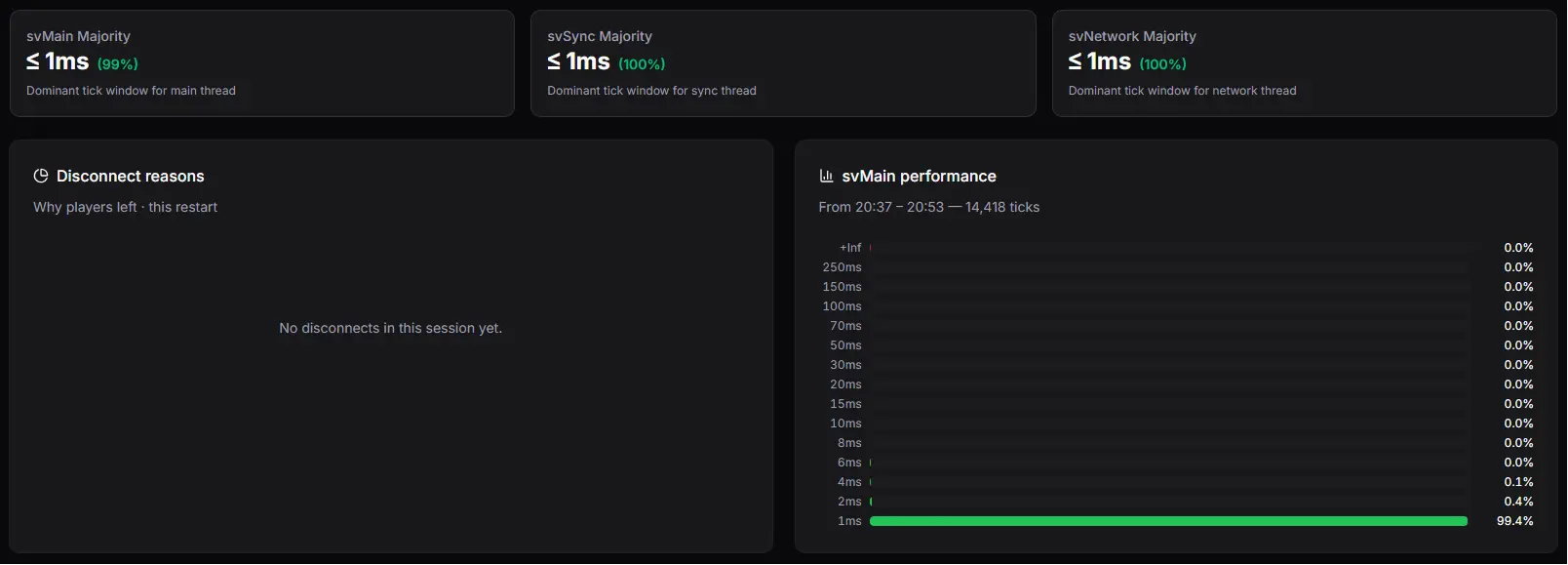
Real-time Threading
Monitor svMain, svSync, and svNetwork threads instantly to identify script bottlenecks before they affect player experience.
Historical Context
Compare current performance against session history to detect gradual degradation or resource leaks over long uptimes.